
Quick Start
Set up Monocle in a few minutes. Create an application in the Spur app, choose how you'll run Monocle, and Monocle confirms the install when it sees your first traffic.
Before you start, you need a Spur account. Sign up or log in.
- 1
Add your application
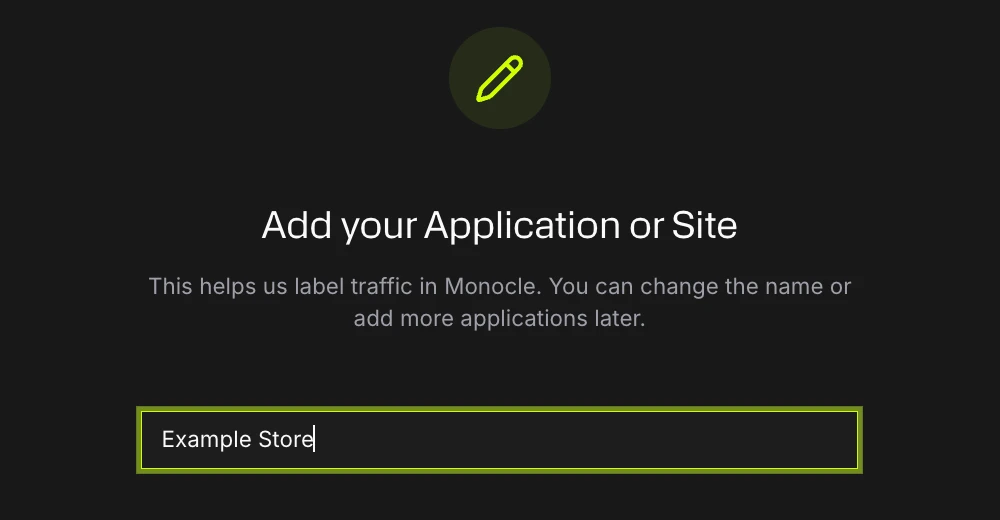
In the Monocle dashboard, select Get Started (your first application) or Add application.
Give your application or site a name. This helps label traffic in Monocle, and you can change the name or add more applications later.
- 2
Select your platform
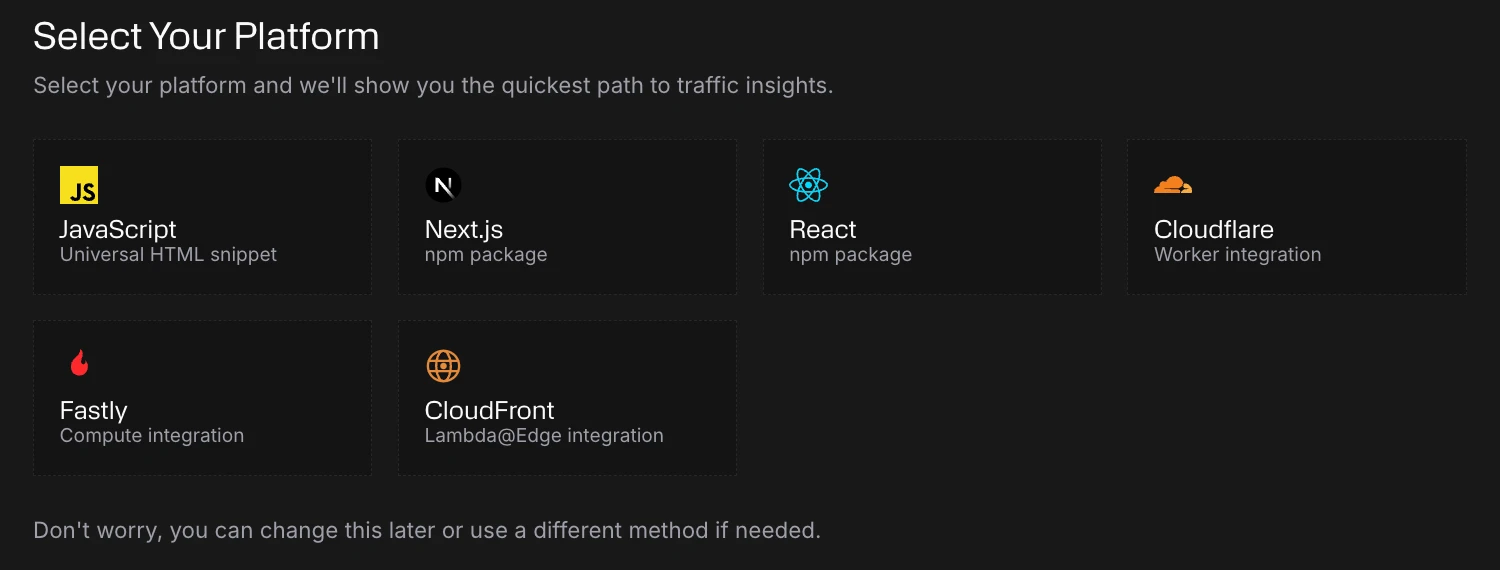
Choose how Monocle will run on your site:
Platform How it works Best for JavaScript Add a script tag to your pages Plain HTML or server-rendered sites Next.js Install the @spur.us/monocle-nextjspackageNext.js apps React Install the @spur.us/monocle-reactpackageReact apps (Vite or your own setup) Cloudflare Monocle deploys a Cloudflare Worker for you Sites behind Cloudflare, with no code changes Fastly Monocle deploys a Fastly Compute service for you Sites behind Fastly, with no code changes CloudFront Monocle connects to your AWS account and deploys a Lambda@Edge integration Sites behind Amazon CloudFront, with no code changes The Cloudflare, Fastly and CloudFront integrations can also enforce your policy at the edge; see Assess & Enforce. With the SDKs, your application enforces decisions itself; see Implementation.
- 3
Install Monocle
Choose how to install: with your AI assistant or manually for JavaScript, React and Next.js, or with an edge integration for Cloudflare, Fastly and CloudFront.
Install with AI
JavaScript, React or Next.js
Let your AI coding assistant do the install.
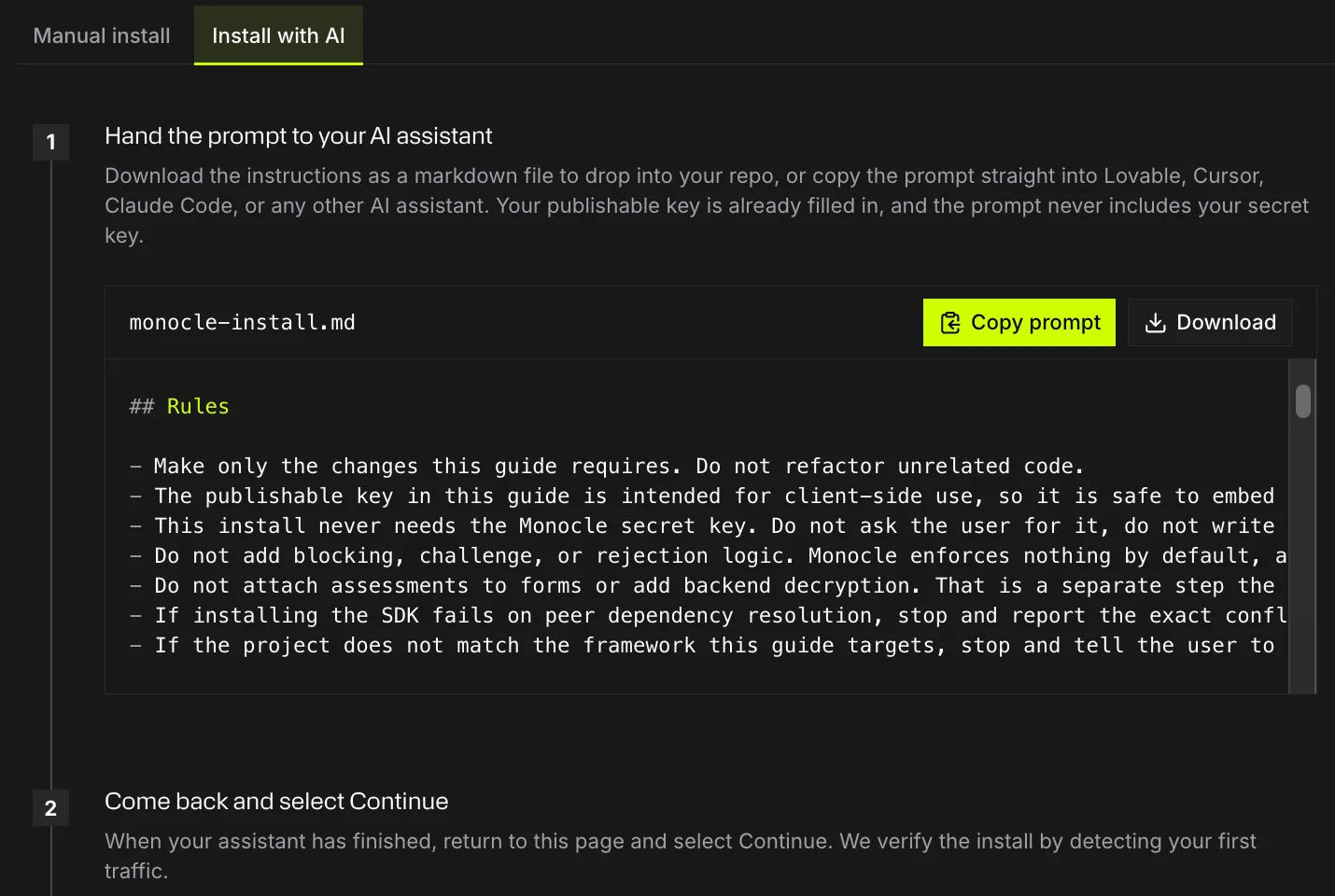
- Open the Install with AI tab.
- Select Copy prompt and paste it into your assistant (for example Lovable, Cursor or Claude Code), or select Download to save the instructions as a markdown file in your repo.
- Let the assistant make the changes.
Your publishable key is already filled in, and the prompt never includes your secret key. The prompt tells the assistant where to add Monocle for your platform, how to handle a content security policy, and how to check its work.
Install manually
JavaScript, React or Next.js
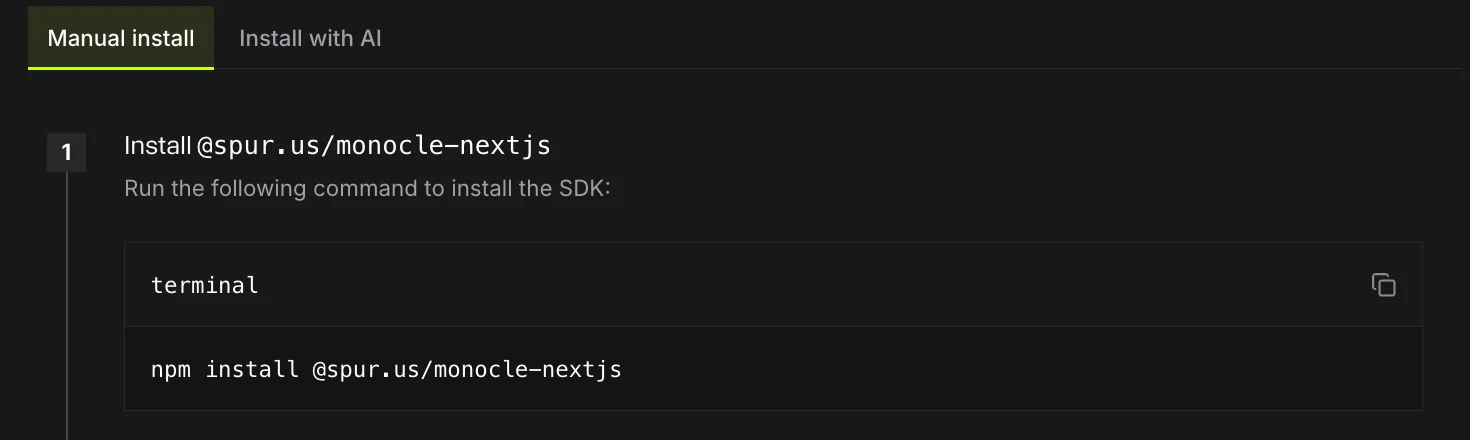
On the Manual install tab, follow the steps for your platform. They match the integration guides:
Deploy an edge integration
Cloudflare, Fastly or CloudFront
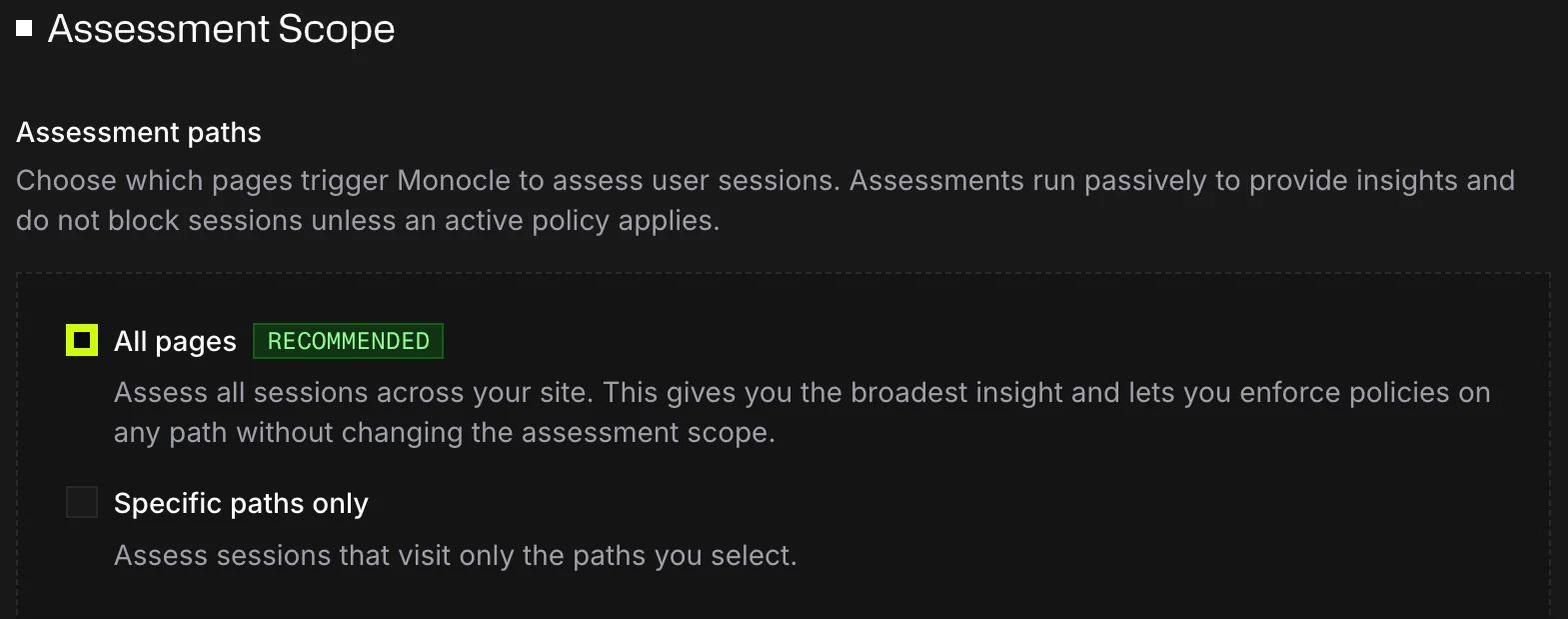
The app walks you through four steps, then deploys Monocle for you:
Step Cloudflare Fastly CloudFront 1 Connect Cloudflare Connect Fastly Connect AWS 2 Domain Domain & Origin Domain 3 Assessment Scope Assessment Scope Assessment Scope 4 Block Response Block Response Block Response Finish Deploy Worker Deploy Service Deploy to CloudFront For what to choose in Assessment Scope and Block Response, see Assess & Enforce. For the connection steps, see the guide for your platform: Cloudflare, Fastly or CloudFront.
- 4
Check it's working
If you installed an SDK, run your app and load a page so Monocle sends its first assessment, then return to the Spur app and select Continue. If you deployed an edge integration, the app takes you to your application once the deploy finishes; visit your site so traffic passes through Monocle.
Monocle shows Watching for Traffic until it detects your first traffic, then Welcome to Monocle! Select View Intelligence to open the dashboard.
To check on an application later, open the application selector at the top of the Monocle dashboard, or search for it in the command palette. The status dot next to each application shows whether Monocle is receiving traffic:
- Gray No traffic seen yet; setup is still in progress
- Green Traffic seen within the application's alert threshold (the last 3 days by default)
- Red No traffic for longer than the application's alert threshold (3 days by default)
Hover over a red dot to see how long ago traffic was last seen. A gray dot shows Setup in Progress. Organization admins can change the threshold under Alert after in the application's Settings, from 1 to 7 days. When an application turns red, organization admins are emailed.

If the dot stays gray after you've loaded your site, check your install against your platform's guide.
Next steps
- Set up a policy to decide which traffic to allow or block
- Explore your traffic on the Monocle dashboard
- Decrypt assessments in your backend, if you use an SDK
- Browse all integrations, including Android, iOS and custom domains